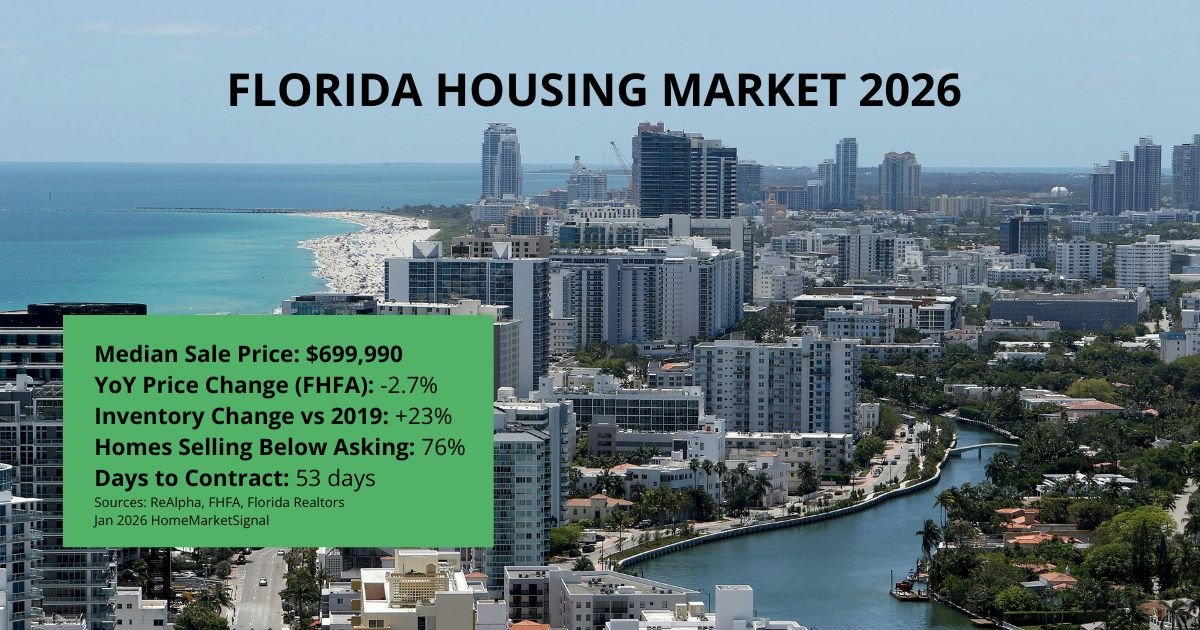
Is 2026 shaping up to be the ideal year to buy a home in Florida? Well, with prices easing off, inventory climbing by 23%, and roughly 76% of homes selling under asking, the Florida housing market in 2026 looks totally different from the hyperactive era of 2020 through 2022. Data shows that Florida recorded the steepest price slip at 2.7% year-over-year. Meanwhile, new pending sales saw a 15.2% bump for single-family homes and a 16.9% jump for condos and townhomes by January 2026. You might wonder what that means practically. It signals a definite cooling but not a full-on freeze.
The ongoing slide in the price-to-income ratio has really shaped this new market reality. Since 2019, home prices have surged around 53%, yet median household income rose only about 24%. That growing gap has stirred a serious affordability crunch. In fact, it’s pushed first-time buyers out of many deals, dropping their share to 21% in 2025. Plus, the average buyer now? About 40 years old. That said, the trend reflects not just rising costs but shifting life stages too.
Current Market Trends and Statistics
Rather than a crash, the numbers for Florida’s 2026 housing scene tell the story of a market adjusting. According to ReAlpha, the median single-family price was about $699,990 as of January, a modest 3.7% bump from the year before. Condo prices ticked up to $420,000… a slight increase but still noteworthy given the broader cooling trend.
Here’s why that matters: these data points show stability creeping back in. Key figures for January 2026 include:
Days to contract: about 53 days for single-family homes, and 71 days for condos. That longer sales cycle hints at balance rather than bidding frenzy. New listings rose roughly 7% year-over-year… helping overall inventory grow by 23% compared with 2019, giving buyers more breathing room than they’ve had in years.
The Federal Housing Finance Agency (FHFA) noted that Florida had the largest year-over-year price slide at 2.7% in Q4 2025. That marks a clean break from the rocket-fueled gains of earlier years. This info comes straight from the FHFA House Price Index, which tracks repeat sales to keep things accurate and comparable.
Inventory and Price Shifts
The months-of-supply figure paints an especially revealing picture. Fort Myers, always a closely watched area, now has about 4.6 months of supply, with a median 119 days to sell. That’s well above the national average; and tellingly, roughly 36.9% of listings there have price cuts. Buyers suddenly have real negotiating leverage not seen in ages.
Across Florida, buyers are managing about 10% off listing prices in some markets. Tampa, for example, has become a hot spot for meaningful discounts. Think about it: that’s a decisive swing away from the seller-friendly years between 2020 and 2024. Clearly, the rules of the game are shifting fast.
Regional Market Breakdowns
Florida’s patchwork of regions means the adjustments aren’t uniform. The Cape Coral–Fort Myers metro area leads in declines, showing around a 9.1% year-over-year dip according to FHFA data. Other regions… less dramatic, but still edging downward in response to affordability limits and renewed buyer caution.
South Florida Market Dynamics
Canvas Real Estate notes that in 2026, South Florida’s market isn’t slowing so much as reshaping. The focus is now on affordability fixes and flexible financing options as traditional buyers feel the squeeze of high prices. Worth noting, many developers are rethinking product lines to match what families can truly afford.
Miami’s investor activity fell 19% year-over-year, which points to fewer speculators and more owner-occupant demand. That’s actually healthy: when homes go to people who live in them instead of flipping them, you get real stability, not just motion in prices.
Southwest Florida Winter Season Activity
According to Bonita Estero Realtors, January 2026 data show that the winter season brought steady demand yet disciplined pricing. It’s an increasingly data-guided environment now, where both buyers and sellers weigh analysis over gut feeling. Simply put, the market’s maturing… people are responding with clearer heads.
What’s Behind the 2026 Housing Market Shift
Rose Quint, NAHB’s assistant vice president of survey research, summed it up plainly: “You can’t have housing prices rise that much for that long and not hit affordability problems.” According to Florida Realtors, that math is catching up. The market correction we’re seeing now isn’t mysterious; it’s economic gravity at work.
In 2025, median home size held steady at about 2,155 square feet, suggesting builders are choosing efficiency over size inflation. They’re adjusting intentionally to meet affordability expectations and tighter budgets. In short, a smart, targeted pivot rather than expansion for its own sake.
Builder Responses and Market Adaptations
Builders are getting creative about affordability. Current figures indicate some 67% of them offer buyer incentives, while about 41% went ahead with direct price cuts. These responses acknowledge that former price levels weren’t sustainable for the average household; it’s a reset moment, honestly.
Among the fresh ideas appearing in 2026 are:
Adaptive reuse projects where commercial spaces or even schools turn into housing units, adding valuable inventory sources. Mixed-density communities blending condos and townhomes offer several price ranges within a single area. Those twin strategies address inventory limits and affordability at the same time. Experts agree this diversification is key to long-term balance.
Investment and Fix-and-Flip Market Opportunities
Here’s what’s interesting: the fix-and-flip scene in 2026 could see real momentum. JBREC highlights three tailwinds driving it forward: price stabilization, improved financing rates, and tax breaks for renovation costs. Together, those create fertile ground for investors focused on adding value… not just speculating.
When prices hold steady, investors don’t fear buying near a peak; plus, cheaper financing lowers carry costs while they upgrade properties. Toss in new deduction perks on renovation work, and you get a compelling equation for a value-first market. Experience shows this setup often kickstarts mid-cycle growth.
Buyer Timing and Opportunities
The question “Are Florida home prices dropping?” doesn’t get a simple yes or no in 2026. Sure, prices dipped slightly, but they didn’t crater. Instead, we’re seeing a cooling phase that savvy buyers can actually use to their advantage if they plan carefully and move decisively.
For the first time in years, the inventory surge gives buyers real options. That 23% boost in available listings since 2019 means people can pick by preferences again… not just grab whatever pops up on the MLS. Important to note, choice has reentered the Florida buying vocabulary.
Best Metros and Market Timing
Fort Myers plus much of the Gulf Coast offer appealing setups for those patient enough to handle longer sales timelines. A median 119-day selling period buys time for proper inspection, negotiation, and, frankly, confidence. And with near 36.9% of listings cutting prices, flexibility is tangible.
Tampa stands out too. Average discounts around 10% from initial asking prices are normal now, not rare. Buyers who’ve done their homework on neighborhood trends and act when stars align are reaping rewards. Real talk: preparation is paying off again.
Long-term Outlook Through 2030
Looking out to 2030, most analysts think 2026 represents a reset phase, not a collapse. Price appreciation of roughly zero to 2% this year suggests the market’s finding sustainable footing. It’s growth, just tempered; and probably healthier long term.
Over the next five years, moderation should continue as both population and housing construction return to tandem growth. Insurance reform ripples through coastal regions still, while inland areas keep attracting those seeking affordability and lower risk. In practice, expect a more predictable climb instead of spikes.
Migration Trends and Demographic Shifts
Florida continues to draw newcomers, though migration is becoming more deliberate. People now weigh value and opportunity rather than moving just for sunshine. This refined migration dynamic might sound subtle, but it promotes genuinely sustainable growth over speculation-fueled surges.
Also, first-time buyers now trending older at 40 years on average changes everything. Life stage timing and budget priorities both play roles. As a result, more buyers prefer turnkey homes and established neighborhoods, shifting the focus away from brand-new developments on the edge of urban areas.
Market Stabilization Factors
A few solid factors underpin this stabilization phase. For starters, Miami’s investor activity falling 19% means less speculative push and a buyer crowd made up increasingly of residents. The result: demand that’s steadier, more genuine. The market breathes easier when people buy to live, not flip.
Meanwhile, fresh contracts are accelerating again: pending sales rose 15.2% for single-family homes and 16.9% for condos and townhomes. Those figures reveal strong underlying demand even with moderated prices. Key point, that’s equilibrium emerging, not a freefall in enthusiasm.
Insurance and Regulatory Impacts
Ongoing insurance reforms continue to shape decision-making, especially along coasts. Details differ regionally, yet risk-based pricing uniformly affects both buyer psychology and property valuations. Inland zones, benefiting from smaller insurance bills, are getting extra attention from value-focused buyers.
Policy changes that encourage adaptive reuse projects and mixed-density housing further help correct affordability issues. Such reforms implicitly recognize that older planning norms alone can’t deliver enough attainable housing stock. Clearly, Florida’s adapting regulation and construction together.
Strategic Recommendations for 2026
Today’s landscape rewards the well-prepared. Buyers who combine patience with strategic timing can benefit significantly from more listings and seller flexibility. Practical approaches include:
Target deals where discounts prevail, especially in areas like Fort Myers and Tampa. Also explore up-and-coming suburbs where infrastructure investment is quietly driving future value without the current cost premium. Experience shows early movers there often win big later.
For sellers, pricing focus is paramount. Homes aligned with what the present market supports, not what 2022 nostalgia suggests, attract qualified buyers faster. Simply put, realistic expectations sell houses.
Investors, meanwhile, are advised to prioritise fix-and-flip opportunities with tangible improvement potential. It’s not about gambling on appreciation anymore; it’s about creating worth through upgrades. With price stability, better financing, and those tax perks, this is a ripe environment for thoughtful value-add projects.
Conclusion: Florida’s Market Reset Creates Opportunities
Florida’s market isn’t collapsing, it’s exhaling. Cooling trends are giving informed buyers an edge: inventories are growing, sellers are adjusting, and negotiation tables are busy again. The 2026 reset marks a long-awaited return to normal real estate rhythms after the wild sprint of 2020–2024.
The tough price-to-income mismatch that fueled change appears to be easing, as values level and incomes inch up. Sure, affordability issues persist, but finally, the direction favours accessibility rather than alienation.
Innovative builder strategies such as adaptive reuse and mixed-density plans are paving the way for new homeowners. Along with roughly two-thirds of builders offering incentives and many cutting prices, these proactive moves prove the industry is adapting thoughtfully, not panicking.
So if you’re eyeing a Florida property in 2026, conditions look healthier than they’ve been in years. Understanding your local submarket, keeping expectations grounded, and jumping when fit and timing align… that’s the winning formula in this cooler but fairer climate.
At the end of the day, the Florida housing market in 2026 reflects maturity: decisions guided by data, not hype. Whether you’re buying, selling, or investing, those who understand and flex with these shifts will uncover real opportunities in the state’s evolving landscape.